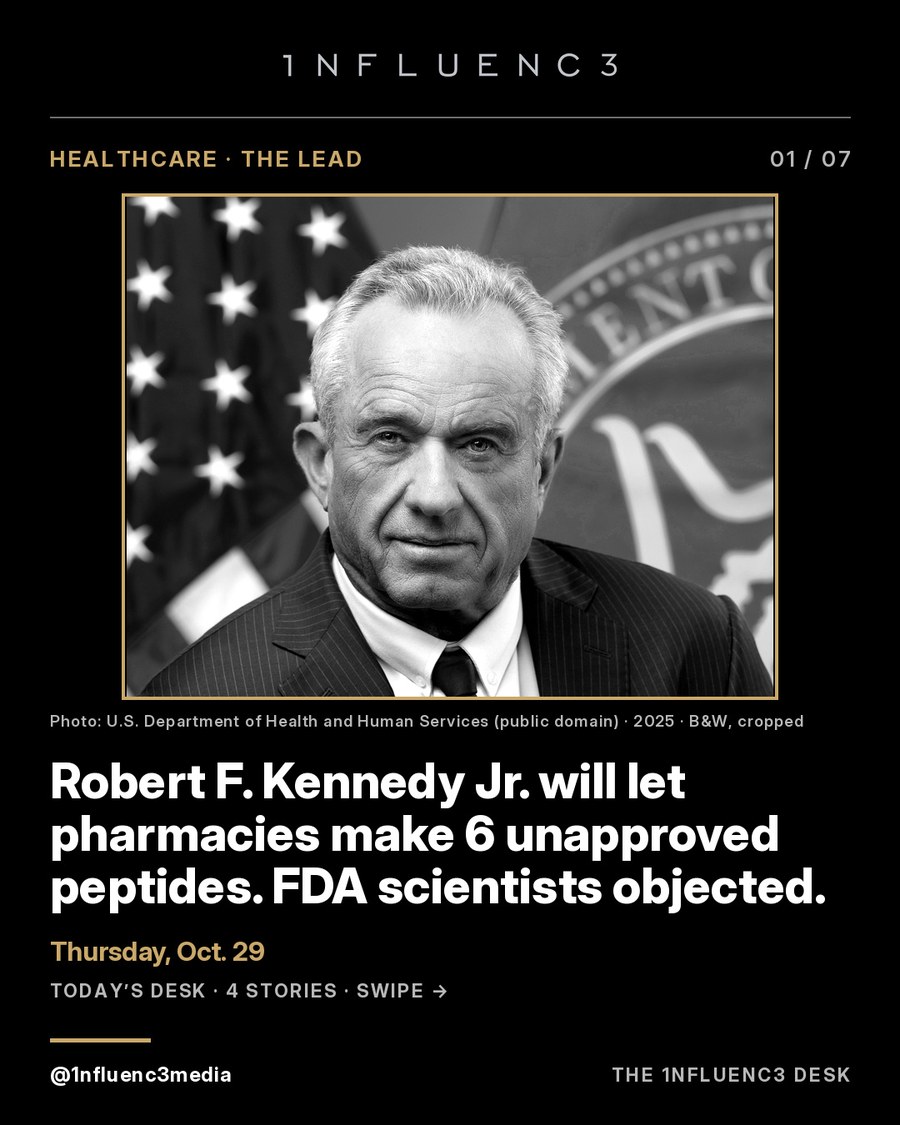
Robert F. Kennedy Jr. will let pharmacies make 6 unapproved peptides. FDA scientists objected.
HHS said on Wednesday, Oct. 28, that it will not take enforcement action when small compounding pharmacies make six peptides the FDA has not approved.
Key Takeaways
- HHS, led by Robert F. Kennedy Jr., will use “enforcement discretion” for six peptides made by small compounding pharmacies, NPR reported. It is not FDA approval.
- An FDA advisory panel backed wider access in July. The FDA’s own scientists disagreed, NPR reported.
- Larger outsourcing facilities are not covered. Pharmacies must report side effects to the FDA, according to NPR.
The Department of Health and Human Services, led by Secretary Robert F. Kennedy Jr., released a policy on Wednesday, Oct. 28, that lets small compounding pharmacies make six peptides the Food and Drug Administration has not approved, NPR reported.
Peptides are strings of amino acids that can have powerful effects in the body. They had been under a federal ban, though versions sold with unproven wellness claims were available online anyway, according to NPR. Two of the six are BPC-157 and TB-500, NBC News reported.
What changed. HHS said it will exercise “enforcement discretion” for the six peptides, NPR reported. In plain terms, the agency will not act against small compounding pharmacies that make them. The peptides have not gone through the FDA’s drug review and approval process.
The objection. A panel of advisers to the FDA voted in July to recommend wider access, partly because people were already buying peptides online, NPR reported. The FDA’s own scientists disagreed. FDA scientists said there was not enough data to show the peptides are safe, NBC News reported.
The guardrails. Pharmacies must use ingredients that meet set standards and report side effects to the FDA, NPR reported. Larger outsourcing facilities, which can make bigger batches, are not covered. “Some people could take one of these peptide substances and not really have any adverse effects. But you’re just rolling the dice, basically,” Dr. Robert Steinbrook of Public Citizen told NPR.
What’s next. The policy was filed for public inspection with the Federal Register.
Also on the Oct. 29 desk. Alphabet’s sales and profit came in below Wall Street’s forecasts, and its shares fell about 11% before trading opened Thursday, CNBC reported. Warren Buffett’s Berkshire Hathaway held about 106 million Alphabet shares on June 30, its filing shows, and Barron’s said the stake is likely now worth less than Berkshire paid. New York Mayor Zohran Mamdani said SNAP shoppers will get 40% more for fresh produce, with the Health Bucks daily cap rising from $10 to $14 in January, according to the city. And Vanke founder Wang Shi, 75, set up a new urban renewal company, Lianhe Zaobao reported.
This is news, not medical or financial advice.
This story runs as an Influence carousel on @1nfluenc3media.See the post →
Sources
- NPR (Sydney Lupkin), “HHS will let pharmacies make popular peptides not approved by the FDA”, Oct. 29, 2026. Link
- NBC News, HHS peptides policy report, Oct. 29, 2026. Link
- AP, peptides and compounding report, Oct. 29, 2026. Link
- Federal Register, public inspection 2026-22192, “Enforcement Discretion Policy Regarding 503A Compounding Using Certain Peptide Bulk Drug Substances”. Link
- CNBC, Alphabet Q3 earnings analyst reaction, Oct. 29, 2026. Link
- Barron’s, Berkshire’s Alphabet stake, Oct. 29, 2026. Link
- NYC Mayor’s Office, Mayor Mamdani announces SNAP users to receive 40% more money for fresh produce, Oct. 29, 2026 (primary). Link
- Lianhe Zaobao, Wang Shi’s new company, Oct. 29, 2026. Link
How we source and correct: Editorial Standards. Spot an error? Tell the desk.
Get the Influence desk in your inbox.
Reporting on the people who move healthcare, real estate, capital, tech, lifestyle & fashion, law and sports, sent to you by email.
We use your email address only to send the newsletter. Every issue includes an unsubscribe link. Privacy Policy