Elon Musk says AI’s real bottleneck isn’t chips. It’s power.
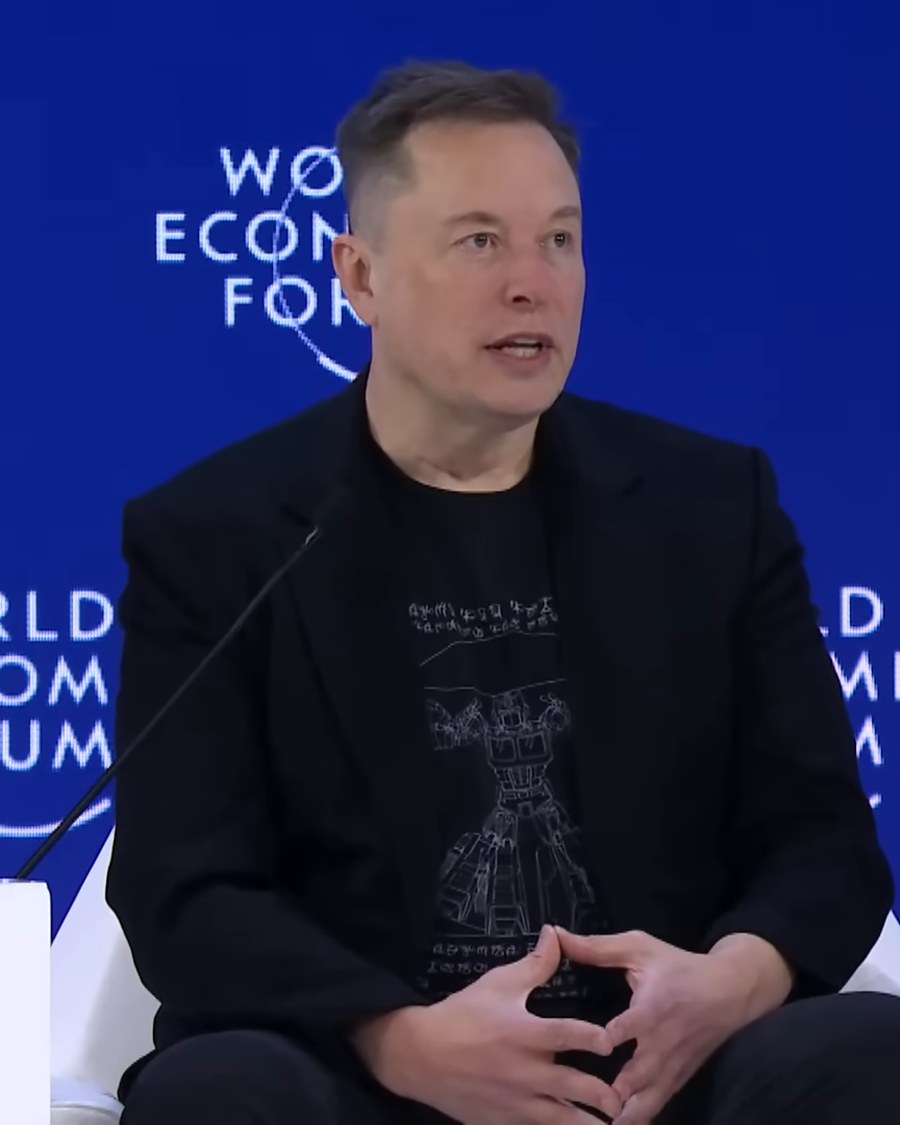
At the World Economic Forum in Davos in January, the Tesla and SpaceX CEO told BlackRock’s Larry Fink that electricity, not chips, now limits how fast AI can spread.
Key Takeaways
- Musk told BlackRock’s Larry Fink at Davos on Jan. 22 that “the limiting factor for AI deployment is fundamentally electrical power.”
- He said AI chip production is rising exponentially, while new electricity comes online far more slowly.
- He predicted that soon “we’ll be producing more chips than we can turn on.”
Elon Musk says the race to build artificial intelligence has hit a new wall, and it isn’t chips. It’s electricity.
“I think the limiting factor for AI deployment is fundamentally electrical power,” Musk said at the World Economic Forum’s Annual Meeting in Davos, Switzerland, on Jan. 22, 2026. “It’s energy.”
The argument. Musk spoke in a session titled “Conversation with Elon Musk,” moderated by Larry Fink, chairman and CEO of BlackRock and interim co-chair of the World Economic Forum. “We’re seeing the rate of AI chip production increase exponentially, but the rate of electricity being brought online is…” Musk said, before Fink put the growth at three to four percent a year.
The warning. “It’s clear that very soon, maybe even later this year, we’ll be producing more chips than we can turn on,” Musk said.
Why it matters now. The clip is from January, but the issue has only grown. Companies are raising record sums to build AI data centers. SpaceX has closed a $40 billion debt financing to buy graphics processing units, CNBC reported on Oct. 26. The same day, Meta said it plans to raise $95 billion in stock to fund AI infrastructure, and CNBC cited a Goldman Sachs estimate that AI-related capital spending could total about $7.6 trillion from 2026 through 2031, across compute, data centers and power. Alphabet said in June it would look to raise $85 billion, and Anthropic is preparing for an initial public offering, CNBC reported.
The stakes. If chips arrive faster than the power to run them, the bottleneck shifts from chipmakers to utilities and grid builders. That is the bet behind Musk’s warning: the AI race may be decided by who can find electricity, not just who can buy the most chips.
Who he is. Musk is the CEO of Tesla and SpaceX, the companies behind electric cars, reusable rockets and Starlink satellites, and, increasingly, AI computing. The World Economic Forum’s session listing also named him chief technology officer of xAI.
The source. Influence’s reel uses a 29-second excerpt of the session. The World Economic Forum published the full conversation on its YouTube channel under a Creative Commons license.
This is news, not financial advice. Quotes are transcribed from the World Economic Forum’s video.
This story runs as an Influence reel on @1nfluenc3media.Watch the reel →
Sources
- World Economic Forum, “Conversation with Elon Musk – World Economic Forum Annual Meeting 2026”, Davos, Jan. 22, 2026 (primary video, CC BY 4.0). Link
- Wikimedia Commons, the same WEF video, license-reviewed CC BY 4.0. Link
- CNBC, “Meta announces $95 billion stock offering to fund AI expansion” (SpaceX $40 billion GPU financing; Goldman Sachs estimate), Oct. 26, 2026. Link
How we source and correct: Editorial Standards. Spot an error? Tell the desk.
Get the Influence desk in your inbox.
Reporting on the people who move healthcare, real estate, capital, tech, lifestyle & fashion, law and sports, sent to you by email.
We use your email address only to send the newsletter. Every issue includes an unsubscribe link. Privacy Policy